Net 15 vs Net 30 for freelancers in 2026 (when each term actually works)
Payment terms decide when cash hits your account and how long you float a client. For US freelancers, consultants, and small agencies in 2026, the real choice is usually Net 15 versus Net 30: what each means, when each fits, and how to push back on Net 45 or Net 60.
This is business practice, not legal advice. Late fees and interest need a prior written agreement. State rules vary.
What do Net 15 and Net 30 mean?
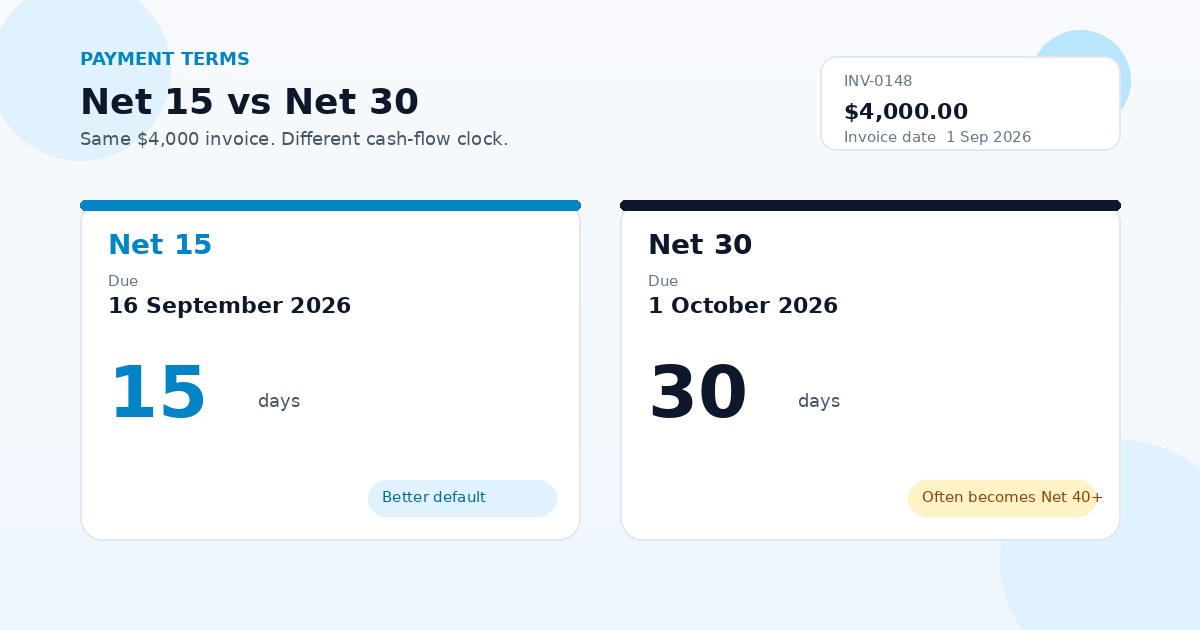
Net 15 means the client owes the full invoice amount within 15 days of the invoice date. Net 30 means within 30 days. "Net" is the balance due after any agreed discounts. The clock usually starts on the invoice date, not the day the client opens the email, unless your contract says otherwise.
Examples: an invoice dated March 1 is due March 16 under Net 15, or March 31 under Net 30. "Due on receipt" still needs a calendar date on the PDF, or it becomes "whenever finance gets to it."
Many freelancers bury "Net 30" in a footer. Finance teams calendar dates, not footnotes. Put the due date next to the amount, with the Net term underneath as the policy that produced it.
Why Net 30 often becomes Net 40 or worse in practice
Net 30 on paper frequently becomes Net 40 or Net 45 in real life because of approval float. The invoice sits with a project manager, then a budget owner, then accounts payable. Each handoff can cost several days before the payment run even starts.
Common float sources: PO or vendor setup (W-9, ACH, purchase order), internal approval batches, twice-monthly payment runs that miss a day-28 clearance, and invoice errors (wrong PO, missing lines, portal rejection) while the clock keeps ticking.
If your cash buffer is thin, that float is the difference between covering rent and putting a personal card on a software bill. Terms are the design. Reminders are maintenance.
Net 15 vs Net 30: cash-flow comparison on a $4,000 invoice
A $4,000 invoice dated the 1st clears much earlier under Net 15 than under Net 30, and the gap widens when approval float adds about ten days. Use the table as a planning model, not a promise of when any specific client will pay.
| Scenario | Invoice date | Stated due date | Likely cleared (~10-day AP float) | Days until cash |
|---|---|---|---|---|
| Net 15, paid on due date | 1 Sep 2026 | 16 Sep 2026 | 16 Sep 2026 | 15 |
| Net 15 + typical float | 1 Sep 2026 | 16 Sep 2026 | ~26 Sep 2026 | ~25 |
| Net 30, paid on due date | 1 Sep 2026 | 1 Oct 2026 | 1 Oct 2026 | 30 |
| Net 30 + typical float | 1 Sep 2026 | 1 Oct 2026 | ~11 Oct 2026 | ~40 |
| Net 45 + float (client push) | 1 Sep 2026 | 16 Oct 2026 | ~26 Oct 2026 | ~55 |
On one $4,000 invoice, Net 30 with float can leave you waiting about two weeks longer than Net 15 with the same float. Stack three invoices and you float five figures. Put terms in the proposal, not only in the footer after delivery.
When is Net 15 the right default?
Net 15 is the better default for most freelancers when the project is under about $5,000, the client is new, or you are floating delivery costs. Shorter terms match how independents actually get paid and cut the chance that "paid on time" still means a long wait.
Use Net 15 (or shorter) for new clients with no payment history, projects under about $5k, work where you float ads or contractors up front, and any month where one late invoice would hurt. Do not grant enterprise float on day one.
Start Net 15. After two or three clean cycles, offer Net 30 as a loyalty upgrade. Clients who balk at Net 15 on a $2,500 project are telling you about their AP culture early.
When is Net 30 reasonable?
Net 30 is reasonable when you bill established clients with clean payment history, or when you sell into enterprise AP that will not (or cannot) run shorter cycles. In those cases Net 30 is often the price of admission, not a personal slight.
Net 30 can make sense for enterprise or mid-market AP (fighting Net 15 may stall onboarding), retainers that already include a deposit, proven payers on the same PO path, and larger invoices (for example $25,000) paired with a deposit so you are not floating everything.
Net 30 is not "professional" and Net 15 is not "aggressive." Professional is a written due date both sides can calendar.
How do you negotiate if the client pushes Net 45 or Net 60?
If a client pushes Net 45 or Net 60, do not accept the float for free. Trade for a deposit, an early-pay discount, interest from the invoice date, or a smaller first invoice. Longer terms are a financing decision. Price that financing or shrink the amount you are financing.
Levers that work in 2026 proposals:
- Deposit or milestones. Example: 40% on kickoff (due on receipt or Net 7), 40% at midpoint, 20% on delivery under Net 15.
- Early-pay discount (2/10 Net 30). Pay within 10 days for 2% off, or the full amount by day 30. Put both dates on the invoice.
- Interest or late fee in writing first. State a monthly rate after the due date in the signed agreement if they insist on Net 45. Enforceability and caps depend on your state (not legal advice).
- Pilot then unlock. Smaller first engagement under Net 15. Longer terms after they prove the payment path. Always print an exact due date ("Due 15 November 2026") instead of burying Net 45 in a SOW appendix.
A line you can adapt:
We can do Net 45 on the final invoice if we bill 50% on kickoff (due within 7 days) and put an exact due date on every PDF. Happy to add a 2/10 early-pay option on the balance.
Should you put the exact due date on every invoice?
Yes. An exact calendar due date on the face of the invoice beats burying "Net 15" or "Net 30" in fine print. Accounts payable calendars dates. Project managers forward PDFs. Your future self needs one unambiguous day to measure "late."
Put amount due and Due: 16 September 2026 near the top, payment method in the same block, invoice and PO numbers if they have them, and a terms line ("Payment terms: Net 15 from invoice date").
For retainers, bill in advance (invoice on the 20th for next month, due Net 15) so you are not delivering a full month on credit. Projects: deposit first, balance on a short net.
FAQ: Net 15 vs Net 30 for freelancers
Here are direct answers to the questions freelancers and small agencies ask most when choosing between Net 15 and Net 30 in 2026, including AP portals that default to Net 45, switching existing clients, and whether late fees apply automatically.
Is Net 15 too aggressive for US freelancers in 2026?
No. Net 15 is a normal default for independents and small agencies on modest invoices, especially with new clients. Many productized offers already use Net 7 or due on receipt. Clear short terms are ordinary cash-flow design, not aggression.
Does Net 30 mean the client can pay on day 30 without being late?
Yes, if your contract and invoice define Net 30 from the invoice date and they pay by that due date. Day 31 is late. Their internal approval delays do not rewrite your due date unless you change it in writing.
What if the client’s AP portal only offers Net 45?
Treat the portal default as their opening offer. Ask for a deposit, milestones, or an early-pay discount before you accept. If the logo is worth the float, shrink first-invoice risk and document exact due dates outside the portal FAQ.
Can I switch an existing client from Net 30 to Net 15?
Yes, with notice on the next SOW, renewal, or rate change. Frame it as your standard under a stated project size, or as the default going forward with Net 30 available after a deposit. Do not surprise them mid-project on work already scoped under Net 30.
Are late fees automatic if someone misses Net 15 or Net 30?
No. Late fees and interest generally need prior written agreement, and rules differ by state. Put fee language in the proposal or contract before the invoice goes out. Terms decide when payment is late; fees are a separate written layer. Not legal advice.
Clear terms beat clever chase copy
The freelancers who get paid earlier in 2026 usually did not invent a better reminder email. They put Net 15 or Net 30 in the proposal, printed an exact due date on the invoice, and stopped financing Net 60 clients for free. Terms are the cash-flow decision. Follow-up enforces the calendar you already set.
If you want that calendar to run without living inside accounting software, Tallylark helps freelancers, consultants, and small agencies who invoice from PDFs, Docs, or simple tools and still need due dates watched. Standalone. No accounting software required. 14-day trial, from $29/mo.