Deposit and retainer invoices for US freelancers and agencies in 2026
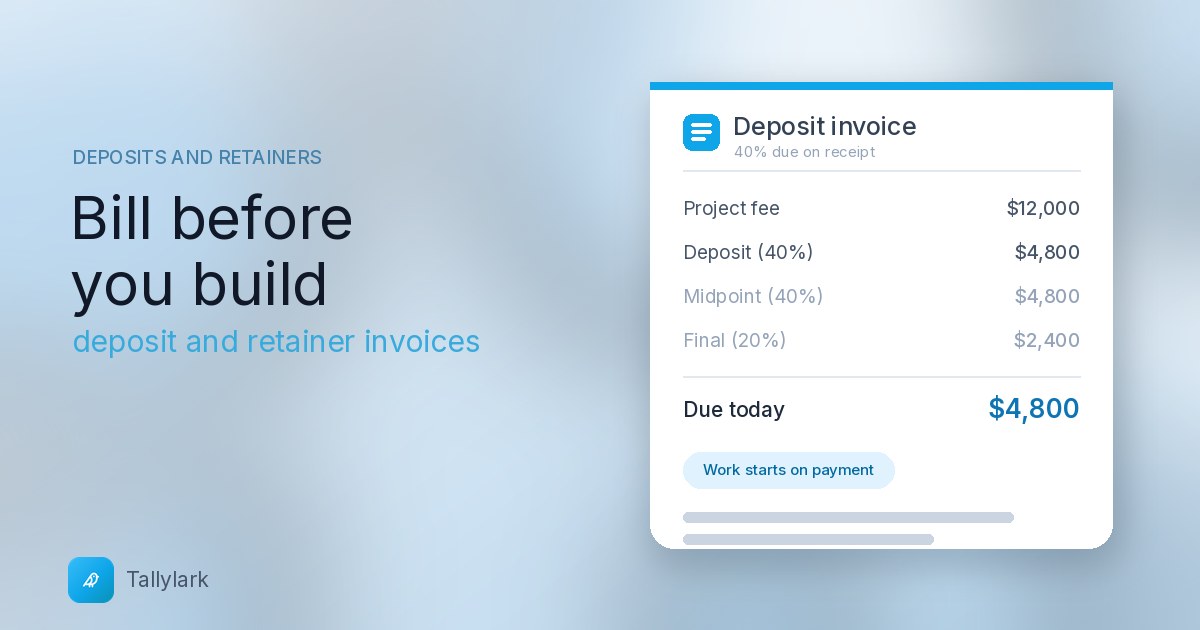
A deposit invoice asks the client to pay part of the project fee before work starts. A retainer invoice bills next month's agreed work in advance. For US freelancers, consultants, and small agencies in 2026, both do the same job: they stop you from funding the client's project with your own time and cash while you wait on Net 30.
Most chasing problems start before the first reminder. If the full fee arrives only after delivery, every late payment lands on work you already finished. Deposits and retainers move part of the risk back to the start, where it belongs. This guide covers how much to ask for, what to put on each invoice, worked line-item examples, and how to handle a client who will not pay up front.
This is business practice, not legal or tax advice. How deposits are treated for tax and whether they are refundable depend on your contract, your state, and your accounting method. Ask your accountant before you change how you book them.
What is a deposit invoice?
A deposit invoice is a short invoice for an agreed share of the project fee, sent at signing and usually due on receipt or within a few days. Work starts when it clears. It references the contract or SOW, states the full project fee, the deposit amount, and what the deposit covers, so the later invoices can credit it cleanly.
A deposit is not a separate charge on top of your fee. It is the first payment toward the fee. That matters when you write the final invoice: the client should see the deposit credited, not billed twice. It also matters if the project ends early, which is why your contract should say whether the deposit is refundable and what it pays for (often scheduling, kickoff, and early work).
How much deposit should a freelancer ask for?
Many freelancers and small agencies ask for 25% to 50% up front on fixed-fee projects, with the balance split across milestones or due on delivery. The right number depends on how much of your cost lands early, how new the client is, and how long the project runs. New clients and long projects justify a larger share.
There is no single standard, so pick a default and write it into your proposal template. A simple way to choose:
| Situation | Typical deposit | Rest of the fee |
|---|---|---|
| Small fixed project, new client | 50% at signing | 50% on delivery, Net 15 |
| Mid-size project, 4 to 8 weeks | 40% at signing | 40% at midpoint, 20% on delivery |
| Large project, 3 months or more | 25% to 30% at signing | Monthly milestone invoices |
| Repeat client with a clean payment history | 0% to 25% | Milestones or Net terms you already trust |
| You buy materials, licenses, or contractor time first | Enough to cover those costs at minimum | Milestones |
If a client pushes back on any deposit at all, that is useful information before kickoff, not after delivery. For how deposits fit with Net 15, Net 30, and longer AP terms, see Net 15 vs Net 30 for freelancers.
What should a deposit invoice include?
A deposit invoice should include the invoice number, the contract or SOW reference, the full project fee, the deposit percentage and amount, a clear due date, one way to pay, and a line saying work begins when the deposit clears. Keep it to one page so the client's AP team can approve it without a call.
Checklist before you send it:
- Invoice number and date. Its own number, not a draft of the final invoice.
- Reference. "Deposit per SOW dated October 5, 2026" or your proposal number.
- Full fee and deposit split. Project fee $12,000. Deposit (40%) $4,800.
- Due date. "Due on receipt" or an exact date. Avoid "ASAP."
- Start condition. "Kickoff is scheduled for the first business day after payment clears."
- Pay method. One primary method (card link, ACH details, or check address).
- Refund terms in one line. Point to the clause in the contract instead of restating it.
Worked example: 40 / 40 / 20 project
| Invoice | When it is sent | Line item | Amount | Due |
|---|---|---|---|---|
| INV-1041 | At signing | Deposit (40%) on $12,000 website project | $4,800 | On receipt |
| INV-1052 | Midpoint sign-off | Milestone 2 (40%) | $4,800 | Net 15 |
| INV-1067 | On delivery | Final (20%) | $2,400 | Net 15 |
Total billed is $12,000. Nothing is billed twice, and each invoice says which share of the fee it covers.
How do you show a deposit on the final invoice?
Show the full project fee, list every earlier payment as a credit with its invoice number, and bill only the remaining balance. The client's AP team can then match each payment to an invoice, and you avoid the "didn't we already pay this?" email that delays the last check.
If you bill in two parts (deposit plus balance), the final invoice looks like this:
| Line | Amount |
|---|---|
| Website project, per SOW dated October 5, 2026 | $12,000 |
| Less deposit paid (INV-1041, paid October 7) | -$4,800 |
| Balance due | $7,200 |
If scope changed, add change orders as their own lines above the credit so the math stays visible.
What is a retainer invoice billed in advance?
A retainer invoice billed in advance charges the client for next month's agreed hours or deliverables before that month starts. You invoice around the 20th for the following month, due by the 1st, so you never deliver a full month on credit. The client gets reserved capacity, and you get paid before the work, not 30 to 45 days after it.
Retainers come in two common shapes, and the invoice should say which one you sold:
| Retainer type | What the client pays for | What the invoice should state |
|---|---|---|
| Hours bank | A set number of hours, for example 20 hours at $150 | Hours included, rate, what happens to unused hours |
| Scope retainer | A defined monthly deliverable, for example 4 blog posts plus reporting | The deliverables for that month, not hours |
Write the rule for unused hours into the contract before month one: roll over (often capped, for example up to one month), use it or lose it, or credit at the end of the term. Pick one and put it on every invoice in a single line, for example "Unused hours roll over one month, max 10."
Worked example: monthly retainer
| Field | Example |
|---|---|
| Invoice | INV-1080, sent October 20, 2026 |
| Period | November 1 to November 30, 2026 |
| Line item | Marketing support retainer, 20 hours at $150 |
| Amount | $3,000 |
| Due | November 1, 2026 |
| Note | Unused October hours (4) roll over to November. Overage billed at $150 per hour on the December invoice. |
What if a client will not pay a deposit?
If a new client refuses any deposit, offer a smaller first milestone instead of dropping the ask. A short paid discovery or kickoff phase works well: the client gets a low-risk start, and you learn how they pay before you commit weeks of work. If they refuse that too, treat it as a signal about the rest of the project.
Ways to keep the ask without stalling the deal:
- Smaller deposit, same rule. 20% instead of 50%, still due before kickoff.
- Paid discovery. A fixed-fee first phase invoiced up front, credited to the main project if they continue.
- Shorter first milestone. Bill the first two weeks as milestone one, Net 7.
- Card on file for retainers. If your payment setup supports it and the client agrees in writing.
If the client is enterprise and their AP system cannot pay before a PO and vendor setup, start the vendor paperwork during the proposal stage, not after kickoff. Ask what their first payment date will realistically be and plan your start date around it.
When should you chase a late deposit?
Chase a late deposit the same way you chase any invoice, with one difference: work has not started, so the start date moves with the payment. Send a short reminder on the due date and another a few days later, and confirm in writing that kickoff is booked for the first business day after the deposit clears.
That is calmer than it sounds. You are not threatening anything. You are telling the client how scheduling works. If the project is already underway and a milestone or retainer invoice goes unpaid, see pausing work for an unpaid invoice for how to suspend delivery with notice, and demand letters for when reminders have run out.
FAQ
Is a 50% deposit normal for freelancers?
It is common for small fixed projects and new clients, and less common for large or long projects, where 25% to 40% plus milestones is easier for clients to approve. What matters more than the number is that it is written into your proposal and contract before work starts.
Is a deposit the same as a retainer?
No. A deposit is the first payment toward one project's fee. A retainer pays in advance for ongoing capacity or deliverables, usually monthly. Some people also use "retainer" for a prepaid balance you draw down; if you do, say so on the invoice.
Should a deposit be refundable?
That depends on your contract. Many freelancers make the deposit non-refundable once kickoff happens because it pays for scheduling and early work. Whatever you choose, write it in the contract and point to that clause on the invoice. Check your state's rules if the amount is large.
Can I charge a late fee on a deposit invoice?
Only if your contract already allows late fees and they are permitted under your state's rules. In practice, a late deposit usually just delays the start date, which is simpler than adding a fee. See late fees for US freelancers for the details.
Do I need accounting software to send deposit invoices?
No. A numbered PDF invoice and a dated email thread are enough for most freelancers. If you already use Xero or QuickBooks Online, use them so deposits and credits match your books, but it is optional.
Soft close: get paid before the work, then let reminders handle the rest
Deposits and retainers will not stop every late payment, but they change what a late payment costs you. When part of the fee arrives before kickoff and retainers are paid before the month starts, a slow AP team delays your next invoice, not your rent.
The invoices that remain, like the midpoint, the final balance, and next month's retainer, still need due dates watched and reminders sent on time. Tallylark does that for freelancers, consultants, and small agencies who invoice from PDFs, Docs, or simple tools. Standalone reminders, with optional one-way Connect to Xero or QuickBooks Online. 14-day Pro trial, about $29/mo after, no card to start.